Large drone platforms are becoming practical tools for mapping, infrastructure inspection, emergency planning, agriculture, and industrial logistics. Their value is no longer measured only by payload size. Buyers now examine flight endurance, sensor integration, maintenance support, data security, and regulatory readiness. The market is moving quickly. Carefully.
Drone Industry Insights’ Drone Market Report 2024 describes continued expansion across commercial and public-sector applications, while MarketsandMarkets forecasts strong growth in the broader commercial drone market through the decade. These reports also reveal an important limitation: market figures differ because suppliers classify aircraft, software, services, and military-free civilian applications differently. Buyers should therefore compare definitions before comparing revenue claims.
A capable large drone may carry a multispectral camera over farmland, inspect a bridge cable in strong wind, or transport equipment across a remote site. Yet performance on a specification sheet does not guarantee field reliability. Real operating conditions matter. A supplier’s test records, pilot training, spare-parts network, software updates, and documented safety procedures deserve close review. Guidance from aviation authorities, including the FAA and EASA, also emphasizes risk assessment, operational limitations, and compliance with local airspace rules.
This guide introduces leading large drone suppliers for global buyers. It focuses on verifiable capabilities, transparent support, and application fit rather than promotional rankings. Some supplier information changes rapidly. That deserves caution. Company websites may highlight maximum endurance, but independent trials and customer references can tell a different story. The strongest purchasing decision combines technical evidence, total ownership cost, local authorization requirements, and a realistic deployment plan.
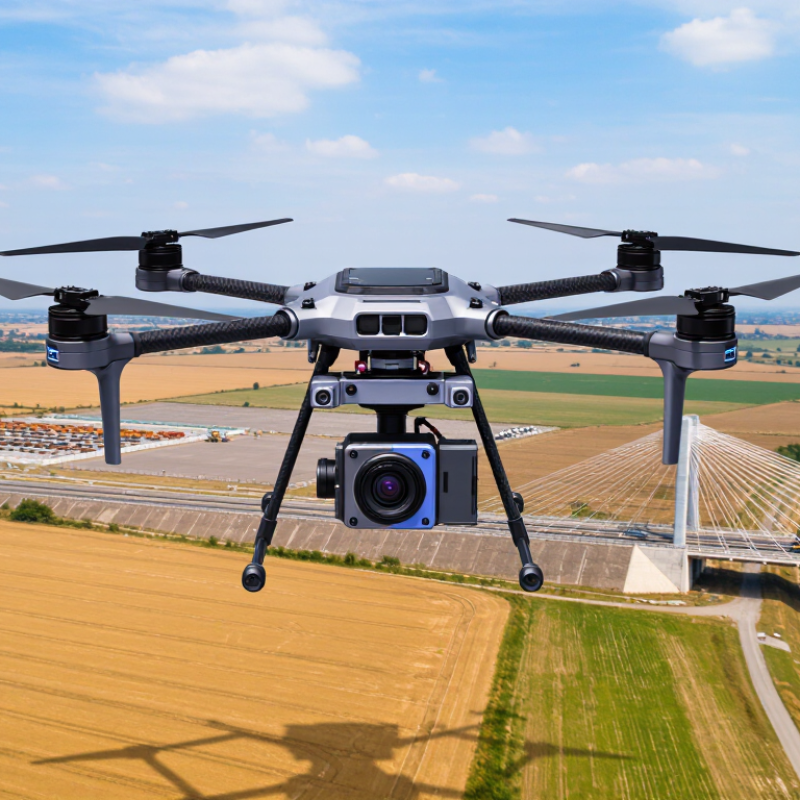
A large drone needs more than an impressive airframe. Buyers should assess maximum takeoff weight (MTOW), payload, and endurance together. A practical benchmark places large drones above 25 kilograms MTOW. Heavy industrial platforms may exceed 150 kilograms, depending on configuration and operating conditions.
Payload is the useful weight carried during flight. It can include cameras, mapping sensors, communication equipment, or sampling tools. A serious evaluation should state payload mass, power demand, and mounting position. For example, a 10-kilogram payload may reduce endurance sharply when it needs continuous electrical power. Empty-aircraft figures can mislead.
Endurance benchmarks should reflect real missions, not ideal laboratory flights. Large electric drones may operate for 30 to 90 minutes with working equipment. Hybrid or fuel-supported systems can reach several hours, but maintenance and operating complexity increase. Wind, temperature, altitude, and battery age also change results. Field teams should request test data under comparable conditions.
These thresholds remain imperfect. A heavier drone is not automatically more capable. A smaller payload may deliver better data when stabilized and powered efficiently. Buyers should compare MTOW margins, usable payload, reserve energy, launch requirements, and service support. Ask for repeatable flight records, not only brochure claims. Small details matter.
Commercial drone demand is moving beyond demonstrations. Drone Industry Insights’ 2024 forecast places the global commercial UAS market near USD 30.6 billion in 2023. It projects approximately USD 54.6 billion by 2030. That growth supports demand for larger aircraft with heavier payloads, longer endurance, and stronger service networks.
The numbers are not perfectly aligned. Grand View Research estimated a similar 2023 market value, but projected a faster growth rate through 2030. This difference reflects varied definitions of commercial drones, software, and services. Buyers should compare the methodology, not only the headline number. The FAA Aerospace Forecast 2024–2044 also indicates continued expansion in commercial UAS operations within the United States.
For global buyers, supplier evaluation should begin with operating evidence. Check flight endurance under wind, not only laboratory figures. Request payload test records, maintenance intervals, spare-part availability, and operator training details. A 20-kilogram payload may look impressive, yet battery performance can fall sharply in cold weather. That matters on remote sites.
Certification documents also deserve close review. So do data-security controls and repair response times. In practical procurement, the cheapest aircraft can create higher lifetime costs. Forecasts are useful, but imperfect. Actual performance depends on terrain, weather, staffing, and local approval procedures. A careful buyer should request a controlled field trial before signing a large supply agreement.
Large-drone buyers should compare specifications under identical test conditions. Grand View Research valued the global commercial drone market at approximately USD 30.6 billion in 2023, showing strong demand for capable industrial platforms. However, market growth does not guarantee useful performance.
MTOW indicates the aircraft’s legal and structural limit, not its practical payload. A supplier listing 25 kilograms MTOW may allow only 6 kilograms of equipment after batteries and safety reserves. Payload should be tested with the intended camera, sensor, or delivery tool installed. Ask for center-of-gravity limits, landing performance, and battery degradation data. Small details matter.
Flight time also needs careful reading. Published endurance often uses light payloads, mild wind, and new batteries. A realistic procurement test should measure hover time with the working payload, at the expected temperature. Thirty minutes can become twenty-two. That difference is costly. The International Energy Agency’s battery analysis continues to highlight temperature and cycling effects on battery performance.
For outdoor operations, IP ratings follow IEC 60529. IP54 offers limited dust protection and resistance to water splashes. IP65 is dust-tight and tolerates water jets, but neither rating confirms safe operation in heavy rain, salt fog, or standing water. Suppliers should provide test reports, temperature ranges, and maintenance intervals. Some specifications still feel optimistic. Buyer audits remain necessary.
| Supplier Reference | Large-Drone Platform Type | Maximum Take-Off Weight (MTOW) | Maximum Payload | Maximum Flight Time | Ingress Protection | Typical Applications | Buyer Considerations |
|---|---|---|---|---|---|---|---|
| Supplier Profile A | Heavy-lift octocopter | 25 kg | 10 kg | Up to 40 min | IP45 | Industrial inspection, cargo delivery, emergency response | High lifting capacity; flight time varies significantly with payload, wind, and battery configuration. |
| Supplier Profile B | Industrial quadcopter | 15.5 kg | 5.5 kg | Up to 55 min | IP54 | Mapping, surveying, power-line inspection, public safety | Balanced payload-to-endurance ratio; suitable for routine commercial missions. |
| Supplier Profile C | Heavy-lift multirotor | 30 kg | 10 kg | Up to 30 min | IP55 | Precision spraying, firefighting support, logistics trials | Designed for demanding outdoor work; maximum payload normally reduces endurance. |
| Supplier Profile D | Hybrid VTOL fixed-wing platform | 25 kg | 2.5 kg | Up to 90 min | IP54 | Long-range surveying, corridor mapping, environmental monitoring | Longer endurance than conventional multirotors; requires sufficient launch and recovery space. |
| Supplier Profile E | Medium heavy-lift hexacopter | 20 kg | 8 kg | Up to 45 min | IP43 | Film production, aerial imaging, construction inspection | Good payload flexibility; lower environmental protection may require weather limitations. |
| Supplier Profile F | Autonomous cargo multirotor | 40 kg | 15 kg | Up to 25 min | IP55 | Medical logistics, remote-site resupply, warehouse-to-site delivery | Optimized for short-range cargo missions; route automation and regulatory approval are key factors. |
Technical note: MTOW means the maximum permitted take-off mass, including the aircraft, batteries, payload, and installed equipment. Flight-time figures are maximum published values under controlled conditions and should not be treated as guaranteed operational endurance.
The specifications are presented as anonymized commercial-platform benchmarks compiled from publicly available manufacturer specification ranges. Buyers should confirm the latest configuration, certification, operating limits, battery options, and regional aviation requirements directly with the supplier before purchase.
For global buyers, a large drone supplier should treat compliance as an engineering requirement, not a sales promise. ICAO provides international guidance, but it does not approve individual aircraft. Buyers should request the operational category, airspace assumptions, and conformity evidence. A useful file includes manuals, maintenance intervals, battery records, and documented flight-test results. Small omissions matter.
In the United States, FAA requirements may involve registration, remote identification, pilot privileges, operational approvals, and airspace coordination. The aircraft’s weight, speed, mission, and control link can change the compliance path. In Europe, EASA rules connect aircraft class, operational risk, and national authority procedures. A supplier serving both markets should separate certified facts from adaptable configurations. Ask for test conditions, revision dates, and responsible engineers. Vague claims age badly.
ASTM UAS standards can support design, testing, parachute performance, command-and-control links, and operational risk analysis. They are technical tools, not automatic permission to fly. During evaluation, buyers can inspect logs, verify software versions, and compare advertised endurance with a loaded flight. A practical trial should include wind, temperature, payload, and lost-link behavior. Results may disappoint. That is useful. Compliance work is rarely perfect on the first review. Record open issues, owners, and closure dates before shipment.
Selecting large drone suppliers requires more than comparing catalog prices. In field procurement, the lowest quote often excludes batteries, training, freight, or software support. Build a scorecard with total landed cost, warranty length, payment terms, and expected operating hours. Request three itemized quotes. Check whether prices remain valid for 90 days. A cheaper airframe can become expensive after repeated battery replacement. This happened in one evaluation. We underestimated charging equipment and revised our model.
Service coverage should be measured by response time, technician access, and regional inventory. Record the nearest support center, working hours, escalation route, and remote-diagnostic capability. A practical KPI is first response within one business day. Another is repair turnaround below ten business days. Ask for service records from comparable fleet sizes. Coverage maps can look impressive but hide long customs delays. Confirm who handles on-site work, travel costs, and operator training. Test support before signing. Send a technical question and measure the reply.
Spare-parts performance deserves its own dashboard. Track fill rate, stockout frequency, average dispatch time, and critical-part availability. Target at least a 95 percent fill rate for routine components. Keep essential motors, controllers, and landing parts locally stocked. Define acceptable substitute parts in writing. Review six months of data, not one promising report. Some suppliers provide excellent initial service, then weaken after warranty expiry. Include post-warranty pricing and annual inventory audits. Update the scorecard quarterly, because operating conditions change.
Global-buyer scorecard based on three practical procurement dimensions: pricing competitiveness, service coverage, and spare-parts readiness.
Scores are normalized on a 0–100 scale. Pricing competitiveness reflects total acquisition value, service coverage measures regional support availability, and spare-parts readiness reflects parts availability and fulfillment performance.