



China Best Autonomous Drone Suppliers for Global Buyers?
China has become a major manufacturing base for autonomous drone systems, supplying platforms for inspection, mapping, agriculture, logistics, and public safety. Global buyers now face a crowded market. The visible aircraft is only part of the decision. Flight-control software, obstacle sensing, battery quality, data security, training, and after-sales support matter just as much.
Drone Industry Insights’ 2024 Drone Market Report describes continued commercial growth, driven by automation, artificial intelligence, and repeatable industrial missions. Grand View Research also forecasts strong expansion in the commercial drone market through 2030. These figures suggest opportunity, but they do not guarantee supplier quality. A low purchase price can hide limited testing, weak documentation, or expensive integration work.
“Autonomy is not a binary thing,” says Dr. Mary L. Cummings, an aviation autonomy expert and former senior advisor to the FAA. Her point is practical. A drone that follows pre-planned routes is not equal to one that safely adapts to changing obstacles, weather, and communications.
This guide examines leading Chinese autonomous drone suppliers through a buyer’s lens. It considers flight performance, sensor options, software compatibility, production experience, certifications, and technical service. Factory visits and pilot projects often reveal details that brochures omit. Battery swaps may take minutes. Firmware support may take weeks.
Some supplier rankings remain imperfect. Public data is uneven, and product specifications can change quickly. Buyers should verify claims through demonstrations, independent testing, sample orders, and written compliance records. The strongest supplier is not always the largest. It is the one that can deliver dependable autonomy, transparent communication, and measurable results across the buyer’s operating environment.
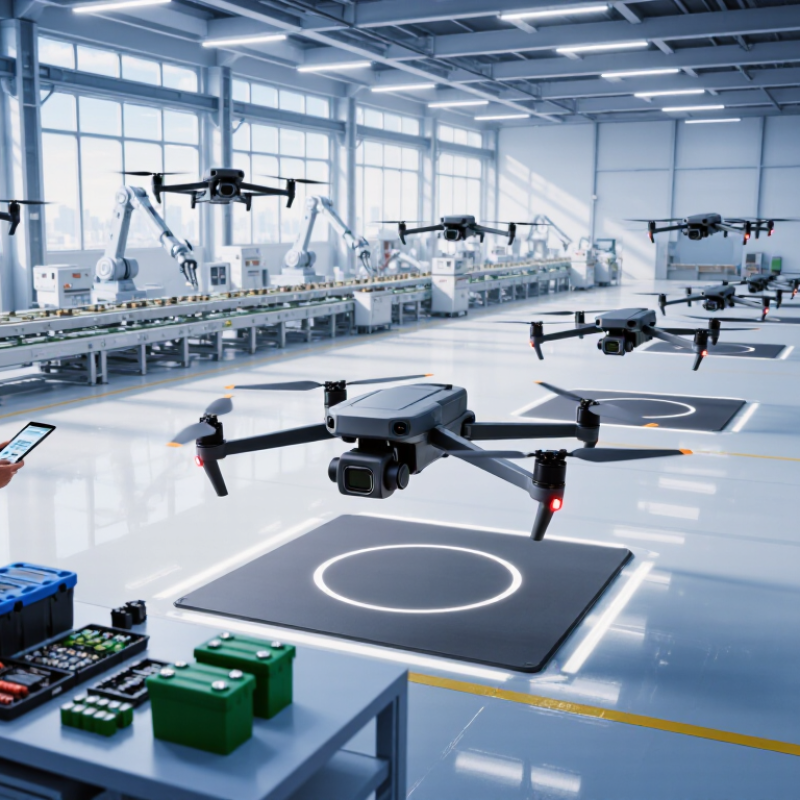
What Defines an Autonomous Drone Supplier in China?
China’s best autonomous drone suppliers are defined by engineering depth, not attractive specifications. An autonomous supplier combines flight control, onboard perception, route planning, communications, and dependable fleet software. It should demonstrate these functions in real conditions, including wind, dust, low light, and weak network coverage.
Drone Industry Insights’ 2024 Drone Market Report estimates the global drone market at about US$54.6 billion in 2024. Its forecast points to continued expansion through 2034, increasing pressure on suppliers to deliver scalable systems. A credible Chinese supplier should provide flight-test records, sensor performance data, software update policies, and traceable quality procedures. Experience matters. Ask for evidence from industrial inspections, mapping, agriculture, or emergency-response training. The supplier should also explain manual intervention limits, cybersecurity controls, data storage, and maintenance intervals. Compliance support for destination-market requirements is essential, although the buyer remains responsible for local approvals. A polished demo is not proof. Hardware can pass a showroom test and still fail beside a steel tower.
Tips: Request a live autonomous mission, not only a video. Check obstacle-detection distance, landing accuracy, battery-cycle results, and recovery behavior after signal loss. Compare at least three suppliers using identical test conditions. Small gaps often reveal large risks. Be cautious with impressive claims lacking independent validation. My own assessment would remain provisional until repeated field trials confirm performance across seasons.
| Supplier Capability Dimension | What a Qualified Chinese Supplier Typically Provides | Evidence Global Buyers Should Request | Operational Relevance | Buyer Assessment |
|---|---|---|---|---|
| Autonomy Architecture | Mission planning, automatic take-off and landing, waypoint navigation, return-to-home logic, geofencing, and fail-safe behavior. | Flight-control documentation, recorded mission demonstrations, failure-response procedures, and software release history. | Shows whether the aircraft is genuinely autonomous rather than only remotely piloted. | Core requirement |
| Navigation and Positioning | Multi-constellation satellite navigation, inertial sensors, barometric altitude sensing, and optional RTK positioning for higher accuracy. | Supported satellite systems, stated positioning accuracy, RTK correction method, and performance tests in partially obstructed environments. | Important for surveying, mapping, infrastructure inspection, and repeatable route execution. | Verify by test |
| Obstacle Detection | Forward, downward, lateral, or omnidirectional sensing using vision, infrared, LiDAR, radar, or combinations of these technologies. | Sensor coverage diagram, minimum detection distance, lighting limitations, avoidance behavior, and test footage. | Reduces collision risk but does not eliminate the need for operational risk assessment. | Application-dependent |
| Beyond-Visual-Line-of-Sight Readiness | Long-range command-and-control options, telemetry monitoring, lost-link procedures, and mission-abort functions. | Communication link specifications, operating-frequency information, redundancy design, and documentation supporting local aviation approval. | BVLOS operation is regulated differently by country and normally requires authority approval or an approved operating framework. | Regulatory review |
| Payload Integration | Payload interfaces for RGB cameras, thermal cameras, multispectral sensors, LiDAR, spraying systems, or delivery modules. | Payload weight limit, power budget, mounting drawings, data interfaces, SDK availability, and compatibility test results. | Determines whether one airframe can support multiple commercial workflows. | Check compatibility |
| Data and Software Control | Ground-control software, mission planning, live telemetry, flight-log export, user permissions, and API or SDK access. | Supported operating systems, data formats, API documentation, cybersecurity controls, update policy, and data-storage locations. | Critical for integration with GIS, asset-management, fleet-management, and enterprise systems. | Integration priority |
| Weather and Environmental Protection | Published operating-temperature limits, wind tolerance, rain resistance, dust protection, and battery operating conditions. | IP rating test report where applicable, environmental test conditions, battery specifications, and maintenance limits. | Performance claims must be matched to the buyer’s climate, terrain, and mission duration. | Demand test data |
| Battery and Flight-Time Transparency | Battery chemistry, charging method, cycle-life guidance, typical flight time, payload-dependent endurance, and spare-battery support. | Flight-time test conditions, payload assumptions, charger specifications, battery transport documentation, and replacement availability. | Advertised endurance is normally affected by payload, wind, temperature, altitude, and reserve requirements. | Compare like-for-like |
| Quality Management | Documented production controls, incoming-material inspection, functional testing, calibration procedures, and serial-number traceability. | Quality-management certificates, inspection plans, sample test records, nonconformity process, and acceptance-test checklist. | Separates repeatable manufacturing capability from one-off prototype production. | Supplier qualification |
| Export and Compliance Support | Commercial invoices, packing lists, user manuals, technical files, battery shipping documents, and assistance with destination-market requirements. | Applicable conformity documents, radio approvals, battery transport test summaries, country-of-origin documentation, and export-control screening process. | Compliance responsibility remains dependent on the destination country, aircraft category, use case, and operating environment. | Country-specific |
| After-Sales Service | Remote diagnostics, firmware support, spare parts, repair procedures, operator training, and warranty handling. | Warranty terms, response-time commitments, spare-parts lead times, training syllabus, and escalation contacts. | Local service coverage can materially affect total cost of ownership and fleet availability. | Contract clearly |
| Customization and OEM/ODM Capability | Airframe, payload, software-interface, battery, branding, packaging, and mission-workflow customization within engineering limits. | Engineering team profile, change-control process, prototype-to-production timeline, tooling ownership, and minimum order requirements. | Useful for specialized applications, but customization can increase validation time and support complexity. | Scope carefully |
| Production and Delivery Capacity | Defined assembly process, component sourcing controls, batch testing, production scheduling, and international logistics coordination. | Factory audit results, realistic monthly capacity, sample lead time, production schedule, inspection terms, and shipment history. | Capacity claims should be validated against the required pilot quantity and future fleet volume. | Audit recommended |
| Total Cost of Ownership | Hardware price combined with batteries, chargers, payloads, software licenses, training, maintenance, repairs, transport, and regulatory costs. | Five-year cost model, consumables list, software-fee schedule, battery-replacement assumptions, and service-price catalogue. | The lowest purchase price does not necessarily produce the lowest operating cost. | Use lifecycle costing |
Note: Specifications, certifications, operating permissions, and export requirements must be verified for the exact aircraft configuration and destination market. Performance figures should be compared only when test conditions and payload assumptions are equivalent.
Related Posts
-
How to Choose the Best Air Drone for Your Needs?
-
Heavy Lift Drone Advantages for Global Buyers in 2026?
-

How to Choose the Best UAV Drone for Your Needs and Budget
-

2026 Top Flying Camera Drone Trends You Need to Know?
-
Top UAV Drone Models for Aerial Photography and Exploration?
-
Best Mini Drones for Beginners in 2026 What to Look For?